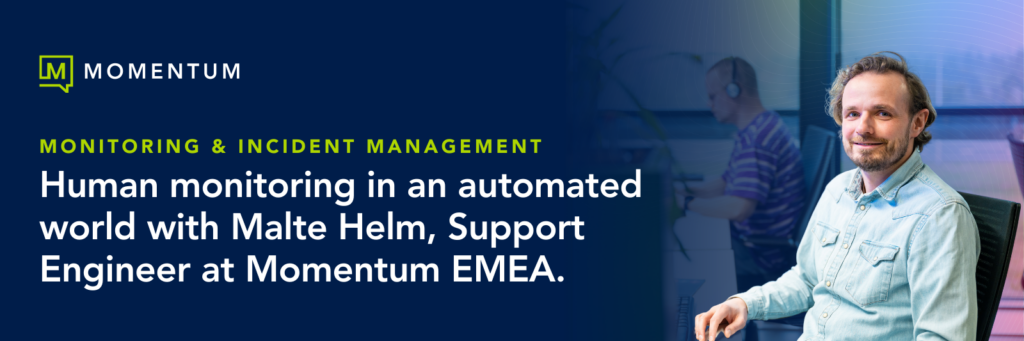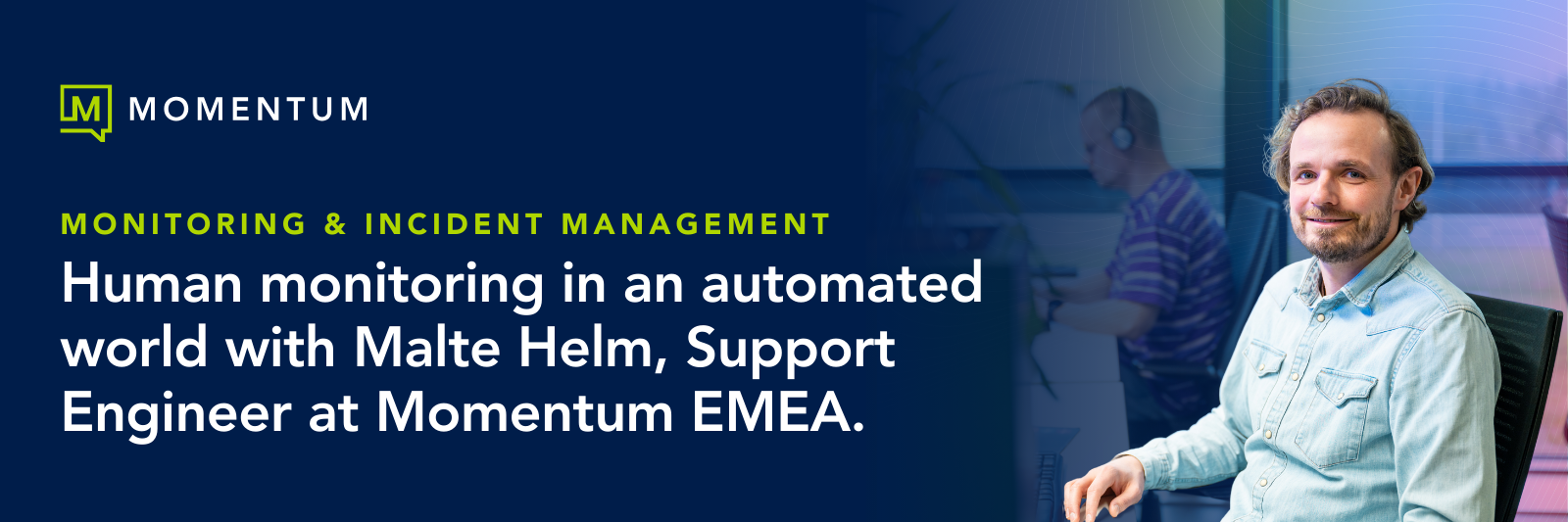
Human monitoring in an automated world
With Malte Helm, Support Engineer at Momentum EMEA.
You probably recognise it. Your dashboard is full of signals. But you still have to decide what really matters. As an IT decision-maker, you don’t want more notifications; you want confidence that your organisation keeps running.
In many organisations, the technology behind monitoring is solid, yet what’s missing is context, ownership and real control. You work with multiple vendors, different portals, and a support model that reacts instead of looking ahead.
In this three-part blog series, we show why more and more organisations deliberately choose a different approach. Not anonymous monitoring, but human monitoring. Each blog highlights one engineer and one moment where the difference becomes visible. In this first story, Malte Helm explains why technology can see a lot. But people make the difference between a notification and a real solution.
Join us at Built for Any Terrain
Technology sees a lot. People see the difference.
AI, algorithms and automated monitoring are getting smarter every day. They detect patterns, predict incidents and sometimes even trigger failovers before anyone has to intervene. But even the best technology has one fundamental limitation: it doesn’t understand why something matters.
- A system can register that ‘something’ is abnormal.
- A person understands the impact on a customer, a team or an entire organisation.
"And that difference is exactly what determines whether an incident is truly resolved."
Malte Helm
From dashboards to meaning
In many organisations, monitoring is still mainly a screen full of numbers and red‑orange‑green blocks. Plenty of data. But insight? That often lags behind. Modern monitoring is no longer about more alerts, but about correctly interpreting what’s happening.
That’s why at Momentum we don’t see monitoring as a set of charts, but as a responsibility. Our technology detects. Our people understand. They know customer environments, prior issues, specific circumstances, and even how a customer works and responds.
As Malte Helm explains: “I see something turn red and I immediately know who to call. And why it matters for that customer right now.” Technology can’t match that kind of context. It sees packets. We see people and processes.
The human layer that makes the difference
Our monitoring starts with smart automation, but it always ends with human attention. Because in practice, we see every day how powerful that combination is.
What we do differently:
- No phone menu. You reach an engineer directly.
- We call customers when we see something. Often before they notice.
- We set priorities based on impact, not a decision tree.
- We truly know customer organisations: who we speak to, what matters, what happened before.
- We don’t just fix issues. We think ahead and prevent recurrence.
It sounds simple, but this is exactly where monitoring often fails with traditional providers: reacting to alerts without knowing the customer behind the alert.
Monitoring becomes more human as technology gets smarter
The more technology can do, the more valuable human interpretation becomes. Not because people are faster. Our systems see everything in milliseconds. But because people understand what a deviation means for your organisation:
- Is a factory at a standstill?
- Is a global Teams environment down?
- Is customer contact being lost?
As Malte Helm says: “Technology detects the fault. Our engineers understand the consequence. And that turns monitoring from a technical activity into a true partnership.”
Why this matters for your organisation
Today, organisations expect continuity. Not tomorrow, but now. That’s why Momentum works with an approach that goes beyond simply ‘keeping an eye on things’.
At Momentum, monitoring isn’t just smart. It’s human-smart:
- 24/7 automated monitoring + engineers who can act immediately.
- Action based on context, not measurements alone.
- Long-standing relationships that help us move faster.
- Proactive communication: from personal calls to bulk updates during major incidents.
- A portal that provides insight. And keeps evolving based on customer feedback.
We believe technology makes monitoring faster, but people make it more reliable. Because ultimately, you don’t just want to know that something is going wrong. You want someone who understands what it means. And what needs to happen next.
Do you recognise this? Alerts come in, but you don’t have the sense of what it really means for your organisation. You work with multiple vendors, different portals and unclear responsibilities. And when things get tense, you’re the one who has to piece the puzzle together.
That’s why organisations increasingly choose Momentum: one team, one portal and one SLA. Not because technology promises it. But because people deliver it.
Discuss what this approach could mean for your environment
Want to discuss what our Monitoring & Incident Management approach could mean for your environment? Schedule a short call with Malte.