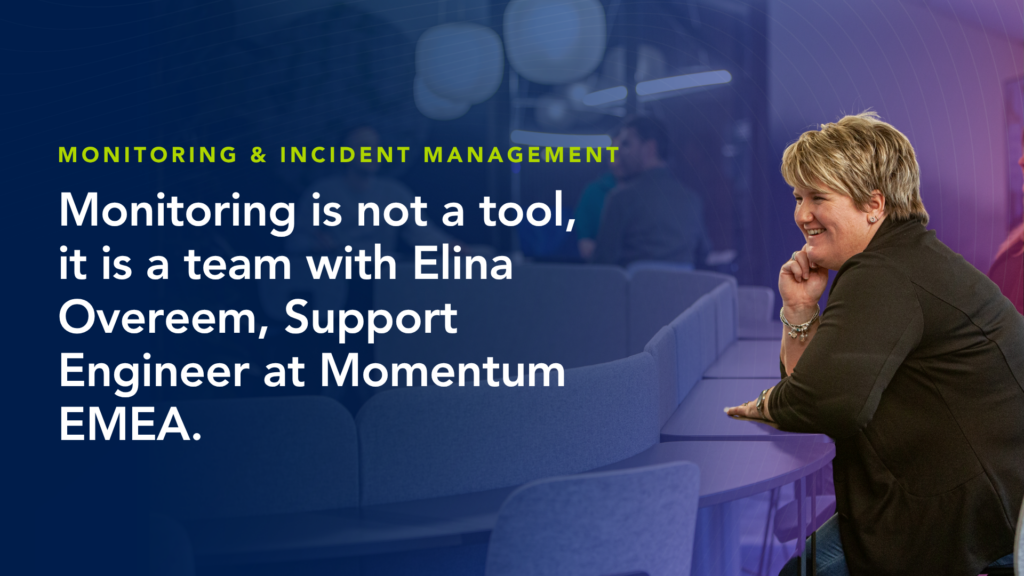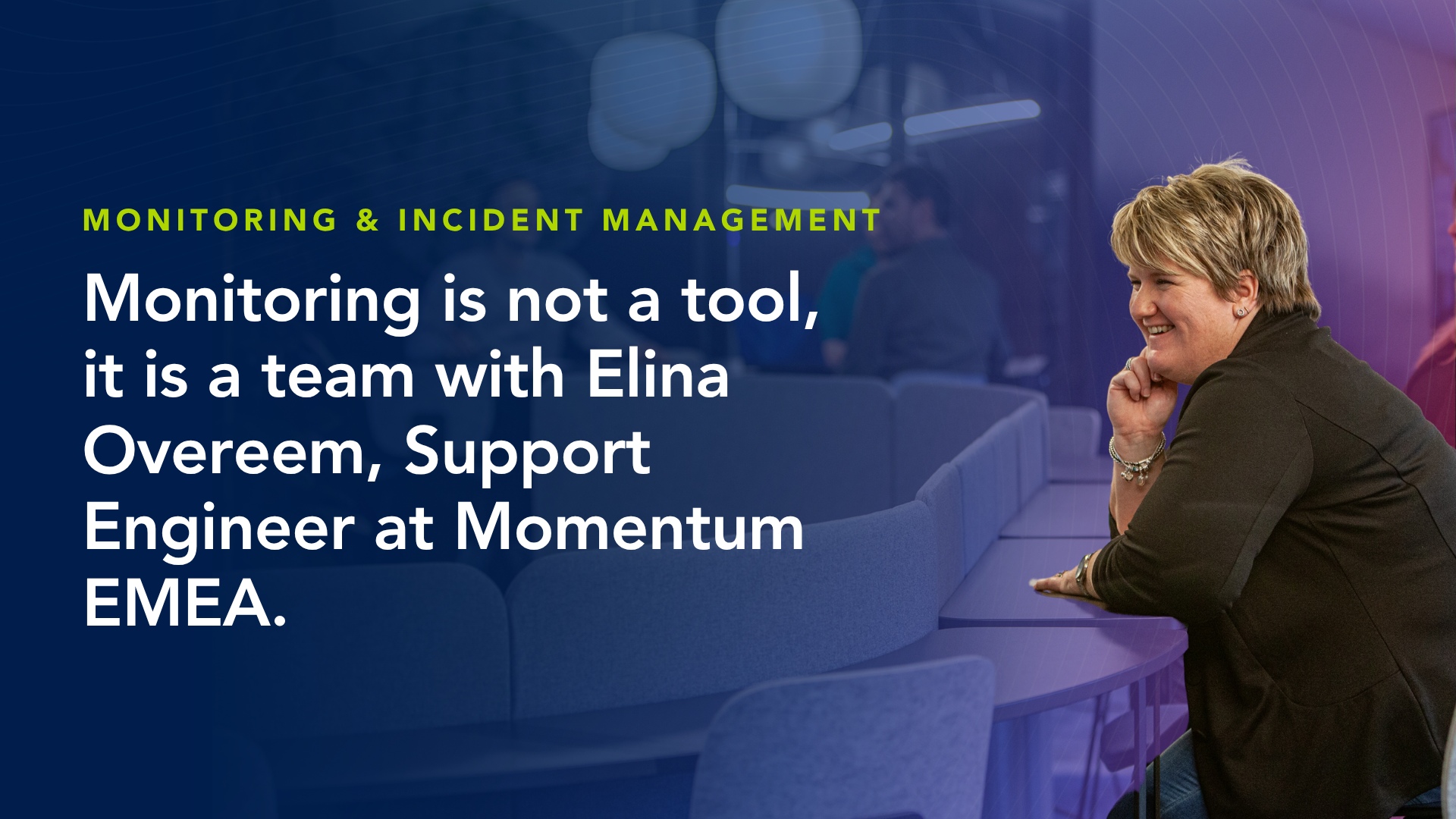
Monitoring is not a tool, it is a team
With Elina Overeem, Support Engineer at Momentum EMEA.
As a network or IT manager, you do not want a ticketing system. You want a team that knows your environment. Yet with many providers, monitoring still feels like a product instead of a collaboration.
You speak to different people each time, you explain your situation again and again, and you only notice during an incident how fragmented the responsibilities are. That is exactly where delays, risks and frustration are created.
In this three part blog series, we show what monitoring looks like when people are back at the centre. Three engineers, three perspectives, one promise. Monitoring only truly works when there is ownership. In this second story, Elina Overeem takes you inside what happens when monitoring is not a tool, but a team that takes responsibility.
Join us at Built for Any Terrain
Automation helps you see. A team helps you understand and act.
n many organisations, monitoring is treated as a technical setup. A platform, a dashboard, a solution that keeps an eye on whether everything still works. But the reality is that the value of monitoring is never in the tool. It is in the people who work with it. Technology detects. People interpret, decide and act.
"At Momentum, we see this every day in our support team. Monitoring is not a checklist. It is a living process where technology and people strengthen each other."
Elina Overeem
When technology stops, the real work begins.
Our systems see exactly when a connection drops, when latency increases, or when a line becomes unstable. But technology does not distinguish between:
- A distribution centre that comes to a standstill because scanners and systems have no connection.
- An office where a backup line keeps things running.
- An organisation that depends on 24 by 7 service.
- A school that cannot start the day.
Our engineers do make that distinction. They know customers, environments and situations. That is why they can respond faster and smarter than any system.
As Elina Overeem says. “I call certain customers as soon as I see red signals, before they even know it themselves, because I know what it means for them.”
That is not a feature. That is involvement.
Building relationships is also monitoring.
What Momentum shows above all is how we make monitoring human by building relationships:
- Engineers know customers by name.
- They know what happened before.
- They get to know new customers even before the contract is signed.
- They adapt their way of working to the customer’s preferences, not the other way around.
That turns monitoring into a collaboration between the customer and the Momentum team, not a cold stream of notifications. Customers know this. If Momentum calls, it matters. And if they call, they reach someone who knows who they are. That is monitoring as partnership.
No phone menu. No bureaucracy. Just action.
In a world where large providers route customers through menus, ticketing systems and queues, we deliberately choose a different path:
- You reach someone directly, no IVR systems.
- Engineers stay on the line until the problem is truly resolved.
- We set priority based on impact, not a pre filled spreadsheet.
- We act even when something is not contractually required, because we understand what is at stake.
That makes monitoring not just a service, but an attitude. As Elina Overeem says. “Even if it is not in the contract, we take action, because we understand it matters.”
A day in our monitoring team.
As soon as we see an incident, we switch within minutes. Not only to measure what is going wrong, but above all to limit the impact for customers:
- We align immediately with the network team and set the first actions in motion.
- We proactively contact customers who are likely to experience the most disruption.
- For larger incidents, we send a bulk update so everyone quickly knows what is happening and what we are doing.
- We explore alternative routes or workarounds to stabilise services as quickly as possible.
- Afterward, we review what we can improve so the same issue does not happen again.
And customers. They usually respond not with irritation, but with trust, because they see someone takes ownership and leads the response immediately. That trust does not come from tools or dashboards. It comes from people.
Why this matters for your organisation
In a world where downtime has direct impact on revenue, operations and reputation, you do not want a supplier who only acts after you call.
You want a team that:
- Sees what is happening before you do.
- Understands the impact.
- Takes action immediately.
- Communicates before you have to ask what is going on.
- Keeps improving, even after the issue is resolved.
Smart technology supports us. But it is our people who make the difference.
Maybe you recognise this. You work with a supplier, but you do not feel a team. You speak to someone different every time, and you have to explain what is happening again and again. And when it really matters, it feels distant.
Momentum is built on a different idea. One dedicated team. One point of contact. One shared responsibility. That is why more and more organisations move from traditional telcos to Momentum.
Want to experience how monitoring feels as collaboration instead of support. Get in touch with Elina Overeem. She will gladly share what this looks like in practice for organisations like yours.
Discuss what this approach could mean for your environment
Want to discuss what our Monitoring & Incident Management approach could mean for your environment? Schedule a short call with Elina.